stack元素元素元素函数可用set和show规则自定义样式。
元素
元素函数可用
set和show规则自定义样式。Arranges content and spacing horizontally or vertically.
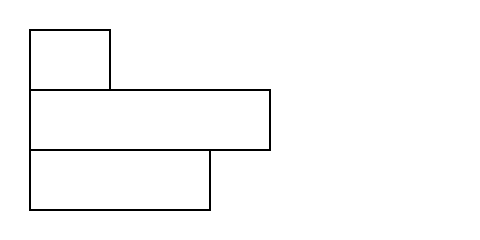
The stack places a list of items along an axis, with optional spacing between each item.
Example
#stack(
  dir: ttb,
  rect(width: 40pt),
  rect(width: 120pt),
  rect(width: 90pt),
)
参数参数参数是传给函数的输入,写在函数名后的括号中。
参数
参数是传给函数的输入,写在函数名后的括号中。
stack(dir:,,)->dir可用set规则可用set规则可用set规则设置参数,更改后续调用时的默认值。
dir可用set规则
可用set规则
可用
set规则设置参数,更改后续调用时的默认值。The direction along which the items are stacked. Possible values are:
ltr: Left to right.rtl: Right to left.ttb: Top to bottom.btt: Bottom to top.
You can use the start and end methods to obtain the initial and
final points (respectively) of a direction, as alignment. You can also
use the axis method to determine whether a direction is
"horizontal" or "vertical". The inv method returns a
direction's inverse direction.
For example, ttb.start() is top, ttb.end() is bottom,
ttb.axis() is "vertical" and ttb.inv() is equal to btt.
默认值:ttb
Spacing to insert between items where no explicit spacing was provided.
默认值:none